
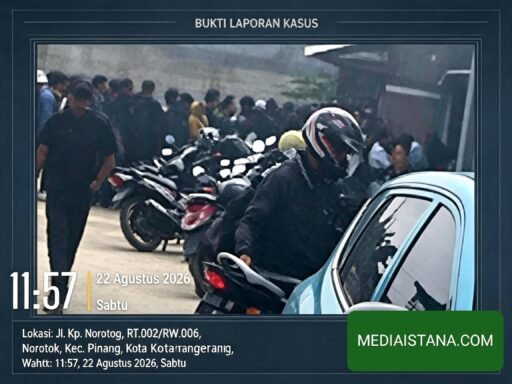
MEDIAISTANA.COM — TANGERANG — AUGUST 26, 2026 — Alleged activities involving the production, mixing, repackaging, and distribution of counterfeit oil in the Kampung Narotok area, RT 002/RW 06, Neroktog Village, Pinang District, Tangerang City, have once again come under public scrutiny.
The issue is not merely related to alleged violations affecting consumers, but also raises serious questions about the effectiveness of supervision and law enforcement in the area.
Information gathered by journalists from several residents and sources in the field indicates alleged activities involving the processing and distribution of oil products that may not comply with applicable regulations. The location, reportedly situated within a residential area, is also alleged to have been operating for a considerable period of time.
However, all of these claims remain allegations and require verification and evidence through official inspections by law enforcement agencies and other competent authorities.
What has drawn particular public attention is the reported location, which is said to be approximately one kilometer from the Cipondoh Police Station. Geographic proximity does not automatically establish that police officers were aware of or involved in the alleged activities. Nevertheless, if an illegal business activity had indeed been operating for an extended period, the situation reasonably raises questions about whether adequate monitoring had taken place.
The questions are straightforward: Has the police ever received complaints from residents? Has an inspection or patrol ever been conducted? Has the legality of the business and warehouse activities ever been examined? If information had previously been received, what actions were taken?
These questions should be answered through evidence and concrete action, rather than statements alone.
Alleged counterfeit oil production is not a trivial matter. If lubricants are counterfeited, mixed, repackaged, or marketed under trademarks without proper authorization, the potential consequences may involve consumer protection, trade regulations, trademark rights, taxation, and even vehicle safety.
Therefore, if evidence of violations is found, authorities should investigate the entire chain of activity—from the source of raw materials and production processes to packaging, trademark use, storage, distribution, and the parties benefiting financially from the activity.
An investigation should also not stop at workers on the ground. If criminal elements are established, investigators should trace the financiers, operators, suppliers, distributors, and any other parties whose involvement can be legally proven.
Meanwhile, information has also emerged regarding alleged payments of approximately Rp50,000 to certain journalists, allegedly associated with journalist identification cards (KTA). Such allegations are serious because they concern the independence and integrity of the journalistic profession.
However, the editorial board emphasizes that these claims must not automatically be treated as established facts without verification.
If there was indeed a practice of providing money with the intention of influencing or stopping news coverage, the matter should be investigated concretely: Who provided the money? Who received it? When and where did the transaction occur? Are there recipient lists, transfer records, communication records, witnesses, or other verifiable evidence?
The press must not be bought. At the same time, the press must not turn rumors into verdicts.
Every journalist has an obligation to maintain independence, verify information, test sources, and provide a fair opportunity for parties being reported to respond. Therefore, if there are journalists who genuinely accepted money to alter or stop reporting, such allegations should be tested against evidence and applicable professional and legal mechanisms, rather than being generalized against the entire journalistic community.
The same principle applies to claims that the alleged operation has existed for decades, has a production capacity of thousands of drums per month, or has a distribution network extending to various parts of Indonesia.
Claims of such magnitude require strong supporting evidence, including production records, transaction data, distribution records, witness statements, physical inspections of products, corporate documents, and other legally admissible evidence.
The media must not turn estimates into facts.
If a large-scale network genuinely exists, law enforcement authorities should be able to demonstrate it through a measurable and evidence-based investigation. Conversely, if the allegations are not proven, the public also has the right to know the outcome of the examination.
Public attention is therefore now directed toward law enforcement authorities and relevant government agencies.
The Cipondoh Police, Tangerang Metro City Police, Jakarta Metropolitan Regional Police, Tangerang City Government, and agencies with authority over trade and consumer protection are expected to conduct professional inspections if there are reports and sufficient preliminary evidence.
The Cipondoh Police Chief should also answer a fundamental public question: Is the police aware of information regarding alleged counterfeit oil production or distribution activities in the Kampung Narotok area?
If so, when was the information received, and what action was taken?
If not, will an inspection be conducted following the emergence of these allegations?
Such answers are important not to prejudge law enforcement officers, but to maintain public confidence in law enforcement institutions.
The Tangerang Metro City Police Chief and the relevant leadership of the Jakarta Metropolitan Regional Police should ensure that, if indications of violations are found, any investigation is conducted comprehensively and does not stop at symbolic or ceremonial action.
If criminal elements are established, the entire chain of activity should be traced on the basis of valid evidence.
Conversely, if an official examination determines that the allegations are unsubstantiated, the results should also be communicated transparently so that no party is subjected to one-sided public judgment.
emphasizes that this report is an investigative news report based on field observations, statements from residents and sources, as well as information and documents received by the editorial board.
All parties mentioned in this report, including the party identified by the initials MDN, have the right to provide clarification, rebuttal, or supporting information. The editorial board is committed to publishing legitimate responses and making corrections if any reported facts are subsequently proven inaccurate.
For the editorial board, this issue is not about creating enemies or destroying anyone’s reputation.
The fundamental question is whether the allegations are true or not.
If illegal activities are proven to exist, the state must act.
If counterfeit products are proven to exist, consumers must be protected.
If attempts to silence the press are proven, they must be exposed.
If law enforcement officials are proven to have abused their authority, they must be held accountable under the law.
But if the allegations are not proven, those accused must also receive justice.
The law must not be defeated by money, but journalism must not replace the legal process.
The public is now waiting for one thing: not drama, not accusations, and not endless disputes—but examination, evidence, transparency, and lawful action.
Red
David E., S.E.
